Monday, October 1, 2018

Counting Pumpkins By Debbie Bravo


Counting Pumpkins Posted By Debbie Bravo


Title: Counting Pumpkins
By: Ellen B. Senisi
Recommended Grade Level: Pre-K
Common Core Standards Addressed:
K.CC4 Understanding the relationship Between Number and quantities; Connect quantity to cardinality

K.OA 1 Represent addition and subtraction with objects, fingers, mental images, drawings, sounds, acting out situations, verbal explanations, expressions, or equations.
K.MD 1 Describe measurable attributes of objects, such as length or weight. Describe several measurable attributes of a single object.

Summary: This book is about two children who count pumpkins. The characters are a boy and a girl. The children count up to 5 pumpkins and then they start counting pumpkins again backwards starting at number 5. The story ends by the children stating that they love pumpkins.  

Rating: I would give this book a 5 stars because it has incorporated math in two different ways. It has counting and then subtraction. The real life pictures in this book makes it easy for children to connect to the real world and I also think that this book can be used during the fall season. I also like how the author incorporated characters who are male and female and with different skin tones.


Classroom Ideas:  With this book I would like to read it at the beginning of October. As children shop in supermarkets they are able to see pumpkins at the store at this time of the year. In the class I hope we can have 2 pumpkins and compare and contrast the shape of them. We can even weight them to show the children about weight and how in the real world we buy fruits or vegetables by weight. I also plan for the children to cut the pumpkin and count the seeds we find inside. Children can also feel the texture of the skin of a pumpkin or the pulp inside.

Ten Apples Up On Top Posted by Shaina Zarzuela


Author: Dr. Seuss
Illustrator: Roy Mckie
Recommended Grade Level: Pre-K - K
CCSSM Content Standards:
Count to tell the number of objects:
·       CCSS.MATH.CONTENT.K.CC.B.4
Understand the relationship between numbers and quantities; connect counting to cardinality.
·       CCSS.MATH.CONTENT.K.CC.B.4.A
When counting objects, say the number names in the standard order, pairing each object with one and only one number name and each number name with one and only one object.
·       CCSS.MATH.CONTENT.K.CC.B.4.B
Understand that the last number name said tells the number of objects counted. The number of objects is the same regardless of their arrangement or the order in which they were counted.

Compare numbers:

·       CCSS.MATH.CONTENT.K.CC.C.6
Identify whether the number of objects in one group is greater than, less than, or equal to the number of objects in another group, e.g., by using matching and counting strategies.

CCSSM Standard for Mathematical Practice:
CCSS.MATH.PRACTICE.MP2 Reason abstractly and quantitatively.

Summary: This book is about thee friends, a lion, a tiger, and a dog, who compete by trying to see who can gradually balance ten apples on their head.
Rating : * * * * * I give this book 5 stars because it is extremely fun while also teaching students math. Students enjoy counting the apples and watching the silly characters balance apples on their heads, which makes it both educational and engaging. The best part of this book is its use of rhyme, which allows the teacher to flow by the book very nicely.


Classroom Ideas/Lesson Ideas:
You can use this book for various activities. My favorite idea is creating a class book, by printing each student’s face and gluing it on a paper. Each student can be assigned a different number of apples and then they would have to glue their apples on top of their heads. This book is perfect for fall and apple theme.


"Uno, Dos, Tres; One, Two, Three"
By: Gabriella Cardos
Image result for uno dos tres one two three by pat mora

By: Pat Mora
Illustrated By: Barbara Lavallee


Recommended Grade Level:
Pre-K/Kindergarten


Common Core Standards Content:

CCSS.Math.Content.K.CC.B.4
Understand the relationship between numbers and quantities; connect counting to cardinality


Common Core State Standards Mathematical Practice:
CCSS.Math.Practice.MP4 Model with mathematics

Summary:
The book tells a story with numbers of two sisters going around buying gifts for their mothers birthday. They stop at different shops picking out things that their mother will like. The story's setting takes place in a Latin/Hispanic influenced town. The numbers are written in English and Spanish. The story starts with uno/one and goes up to diez/ten.

Rating:
5 Stars

Classroom/Lesson Ideas:
This book shows a lot of Latin/Hispanic culture in the pictures. I would recommend reading this story during your multicultural lessons. I would also use this book in the beginning of the year if you have ELL's in the classroom. This helps them with connecting their numbers from Spanish to English. Around Mother's Day is also a time that you could take out this book. Children love to create or give gifts to their mothers.


Ten Apples Up on Top!

Ten Apples Up on Top!

Posted by Solange Ortiz


Title: Ten Apples Up on Top!
Author: Dr.Seuss and Theo LeSieg
Illustrator: Roy McKie
Recommended Grade Level: Grades Pre-K – 2

Common Core Standards Addressed:

CCSS.MATH.CONTENT.K.CC.B.4
Understand the relationship between numbers and quantities; connect counting to cardinality.
CCSS.MATH.CONTENT.K.CC.B.4.B
Understand that the last number name said tells the number of objects counted. The number of objects is the same regardless of their arrangement or the order in which they were counted.

 CCSSM Standard for Mathematical Practice

CCSS.MATH.PRACTICE.MP2 Reason abstractly and quantitatively


Summary: This story is about three friends, a lion, a dog, and a tiger. They are trying to balance apples on their head while competing with each other. They show one another that they can balance apples while they skate, jump and drink milk; in addition, to watching out for the bear coming through with the mop!

Rating: 5 Stars *****
This is an amazing book for learning how to count and add. The story is funny, silly and the illustrations are child-friendly.  The rhymes used and the character dialogue is brilliant as well as humorous.

Classroom ideas:

This book is a good start for the mathematical concept of counting and addition. As the teacher read the story she/he can point out to the students that the characters are adding “1 more” apple to their heads as the story unfolds. Furthermore, as the characters add apples to their heads, the students can take turns counting how many apples each character has. At the end of the story the students can be asked, “How many apples did the lion, tiger or dog end up having on their heads?” In addition, the teacher can invite the students to draw themselves and to add apples to their drawings head just like the animals in the story. Furthermore, play dough or small wooden blocks can be provided as an alternative for the students who do not wish to draw.  Every student will follow similar instructions and will use the play dough or the blocks to represent the apples as they count from 1- 10.


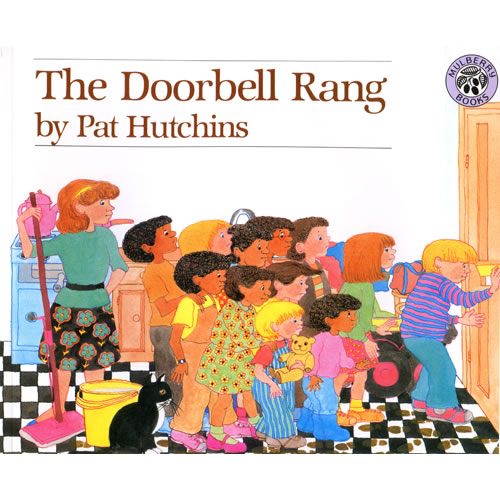
The Doobell Rang


The Doorbell Rang
 Related image

Posted by: Tanya McGhee
Author and Illustrator: Pat Hutchins

Recommended Grade Level: Pre-k, Kindergarten, 1st Grade and 2nd Grade
CCSSM Content Standards:

CCSS.Math.Content.K.CC.B.4
Understand the relationship between numbers and quantities; connect counting to cardinality.
CCSS.Math.Content.K.CC.B.5
Count to answer "how many?" questions about as many as 20 things arranged in a line, a rectangular array, or a circle, or as many as 10 things in a scattered configuration; given a number from 1-20, count out that many objects.CCSSM 

Standard for Mathematical Practice:
CCSS.Math.Content.K.CC.C.6
Identify whether the number of objects in one group is greater than, less than, or equal to the number of objects in another group, e.g., by using matching and counting strategies. Understand the relationship between numbers and quantities; connect counting to cardinality.

Summary: This book is about a mother who made
a batch of a dozen chocolate chip cookies for her children Victoria and Sam. Each child has six cookies. But when the doorbell rings and friends drop by, the cookies must be shared.
Rating: I will give this book 5 Stars because it not only teaches children counting and cardinality, problem solving, addition, subtraction and even can be used to teach division.  It also teaches them about sharing.

Classroom Ideas/Lesson Ideas:  This book can be used to teach counting in sequence as well as subtraction, addition and division.  Another way in which this book can be used is teaching children how to share.  Allowing them to use problem solving to figure out how many cookies each person will get depending on how many cookies and children there are.


"THE SHAPE OF THINGS"  Posted by Ketty D. Duberry Title: "THE SHAPE OF THINGS" Author: Dayle Ann Dodds ...